
ICE Missed Its Own 48-Hour Deadline in 84 Percent of Texas Detainer Cases

Artem Kolisnichenko
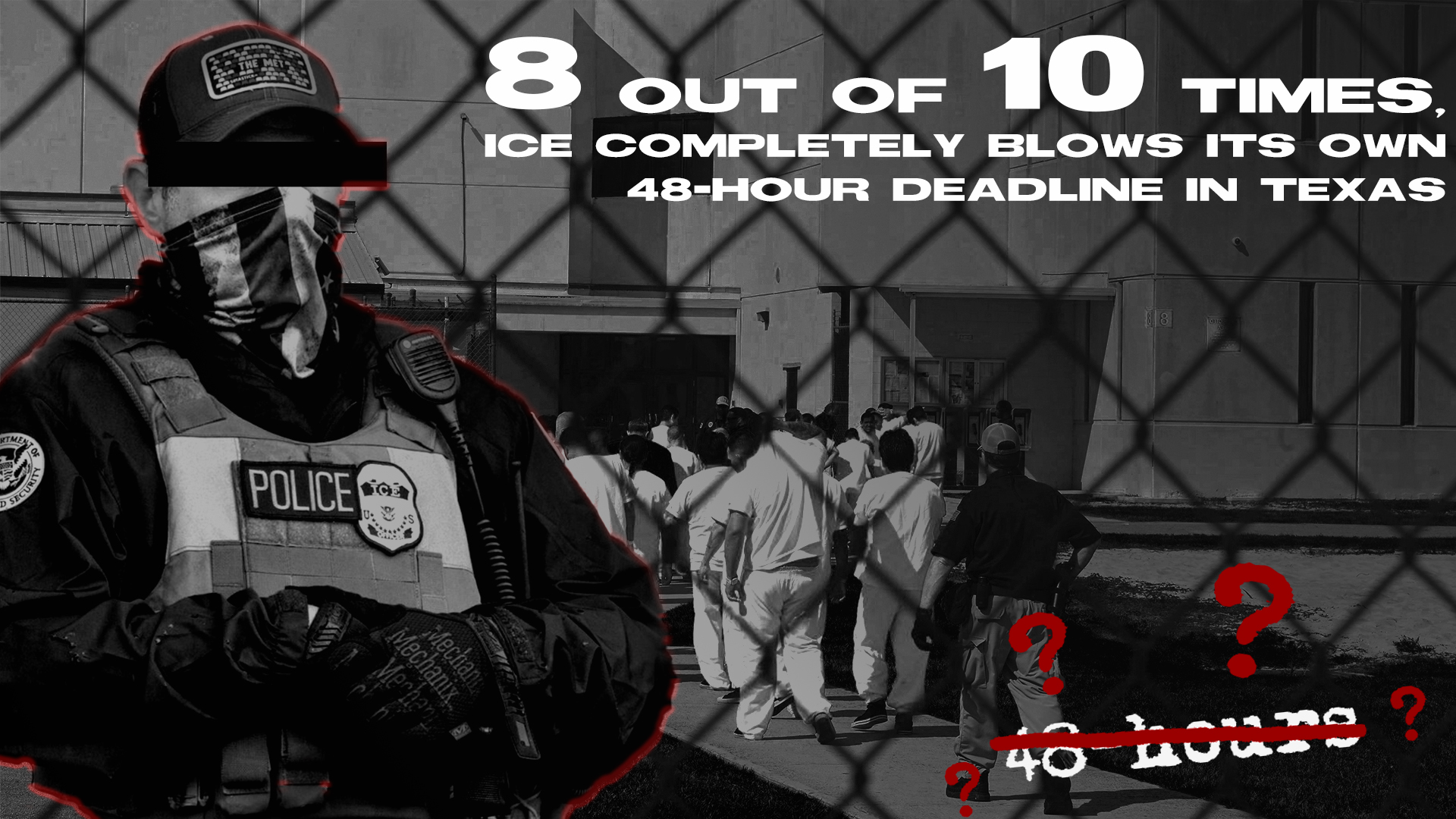
More than 2,100 people sat in Texas county jails waiting for ICE past the agency’s own 48-hour limit between January and March. Federal records, obtained under a FOIA settlement and analyzed here for the first time, show ICE hit that window just 16.2 percent of the time. The median wait was nearly five days.
County jails across Texas held people on ICE detainers long after they were legally due for release. ICE’s own form, the standard I-247A detainer, gives the agency 48 hours to come collect. Federal records show it missed that window in 84 percent of Texas pickups. Between January 1 and March 10, 2026, ICE filed 6,156 detainers across Texas facilities. 4,792 people received one. 2,553, or 53.3 percent, eventually went into ICE custody. Only 413 of those transfers happened within 48 hours. That is 16.2 percent. The median wait: 116.7 hours, just under five days. The records come from the Deportation Data Project, which received them under a FOIA court settlement on March 30, 2026. This analysis merges the Texas export with the national stints dataset, tracking people transferred to ICE facilities outside the state. The Texas-only export put the custody match rate at 28.3 percent. Adding the national stints data pushes it to 53.3 percent, because people transferred out of state did not appear in the state-level records. The 48-hour limit is not agency guidance. It comes from two federal court rulings. In Galarza v. Szalczyk, the Third Circuit held that holding someone beyond 48 hours on a civil detainer without a judicial warrant raises Fourth Amendment concerns. Miranda-Olivares v. Clackamas County reached the same conclusion in the District of Oregon. ICE wrote the limit directly into Form I-247A. 35.2 percent of the 2,553 matched detainees reached ICE custody within 72 hours. 56.1 percent within seven days. 95.9 percent within 30 days. 104 people waited longer than a month. The dataset does not record how long the longest cases ran.
Field Offices
ICE divides Texas across five Areas of Responsibility. San Antonio led the state, transferring 23.5 percent of its 340 matched cases within 48 hours at a median of 64 hours. Houston was slowest: of 249 matched cases, only 11.2 percent transferred within 48 hours and the median reached 132 hours. Harlingen posted 21.0 percent within 48 hours at a 76-hour median, followed by Dallas at 18.2 percent and 94.5 hours, and El Paso at 16.5 percent and 88 hours across 13 matched cases. Houston converts the highest share of its detainers into actual custody at 40.1 percent and picks up more people than any other office in the state. It also takes the longest to do so, logging the highest share of cases running past 30 days at 9.0 percent, against 8.2 percent in San Antonio, 5.8 percent in Dallas, and 4.9 percent in Harlingen.
County Variation
Harris County, inside the Houston AOR, processed 339 matched detainees at a median of 71 hours. Galveston County’s median was 59 hours. Both are faster than any Texas field office average, including San Antonio, and both fall under the Houston AOR. Travis County filed 268 sheriff detainers, third-highest in the state. Of 121 matched detainees, 14.9 percent reached ICE custody within 48 hours. The median: 149 hours. Montgomery County ran 219 hours. Brazos County hit 406 hours, nearly 17 days. Tarrant County averaged 411 people per day on active ICE detainers in the first quarter of 2026, the third-largest detainer population in Texas behind Harris County at 996 and Dallas County at 684. Only 18 Tarrant detainees show up in the ICE custody data for the period. The Texas Commission on Jail Standards counted 534 detainers at Tarrant facilities, more than six times that figure.
Who Was Detained
The 6,156 detainers touched people from 99 countries. More than half were Mexican nationals: 3,411, or 55.4 percent of the total. Hondurans ranked second at 833. Guatemala, Venezuela, and El Salvador followed. Males received 5,579 detainers, 90.6 percent of all filings. ICE classified 17.8 percent of Texas detainees as having no criminal conviction and no pending charges at the time the detainer went out. Another 64.5 percent carried pending criminal charges, a category that, per ICE’s own methodology, includes cases where charges were never formally filed or have since been dropped. 17.7 percent the agency classified as convicted criminals. On threat level, 41 percent were assigned Level 3, the lowest enforcement tier. 26 percent were Level 1, the highest. 18 percent had no threat level on record.
Detainer Types and County Concentration
Of the 6,156 detainers, 5,927, or 96.3 percent, are standard I-247A administrative detainers. Another 158 are I-247G notification-only filings, which carry no 48-hour hold authority. ICE filed 162 detainers against people it already held when the paperwork went through. This analysis excludes those in-custody lodges from the 48-hour calculation. Of 254 Texas counties, 80 received no sheriff detainers during the period. Nineteen counties received 50 or more, accounting for 73.6 percent of all sheriff-attributed detainers. The top five, Harris, Dallas, Hidalgo, Travis, and Bexar, account for 44.8 percent. Harris County alone filed 729, or 17.5 percent of the statewide sheriff total.
You can find the methodology and a detailed analysis of the data in . The illustration for the article was prepared by @cute_сhaika
Our contacts:
contact@texasborderexaminer.com
editor@texasborderexaminer.com
© 2026 TEXAS BORDER EXAMINER
